Turn fragmented healthcare data into clearer operational decisions
Datazeb helps healthcare organisations connect approved data from clinical, pharmacy, appointment, patient, finance, and operational systems into reliable analytics and reporting.
The key is not simply connecting systems. Data often needs mapping, validation, standardisation, and reconciliation before it becomes reliable enough for operational reporting.
01Healthcare Systems
Appointments
Patients
Prescriptions
Dispensing
Clinicians
02Integration
APIs
Exports
Database links
03Validation & Mapping
Clinician mapping
Site mapping
Code validation
04Trusted Data
Privacy-aware model
Role-based access
05Power BI / Decisions
Operational BI
Management KPIs
Alerts
The healthcare data problem
Healthcare organisations rarely have one source of truth
Operational and management reporting can depend on multiple systems that were designed for different purposes.
Patient and appointment systems
Prescription and dispensing platforms
Clinical systems
Doctor / clinician master data
Finance and billing systems
Pharmacy or inventory platforms
Manual spreadsheets
External APIs and third-party data
What Datazeb can deliver
01
Healthcare Management Dashboards
Operational and management reporting across patient activity, appointments, dispensing, service performance, and business KPIs.
02
Patient & Appointment Analytics
Structured reporting around activity, visit patterns, bookings, cancellations, utilisation, and service trends.
03
Prescription & Dispensing Analytics
Reporting and reconciliation across prescribing, dispensing, product, clinician, and patient-related data where approved.
04
Clinician / Doctor Mapping
Standardise identifiers and relationships across source systems to improve reporting consistency.
05
Healthcare Data Integration
Connect APIs, databases, files, and approved healthcare systems into a structured reporting environment.
06
Data Quality & Exception Monitoring
Identify missing values, duplicates, mismatches, invalid relationships, and late or incomplete source feeds.
07
Automated Reporting
Reduce recurring spreadsheet preparation through scheduled data processing and Power BI reporting.
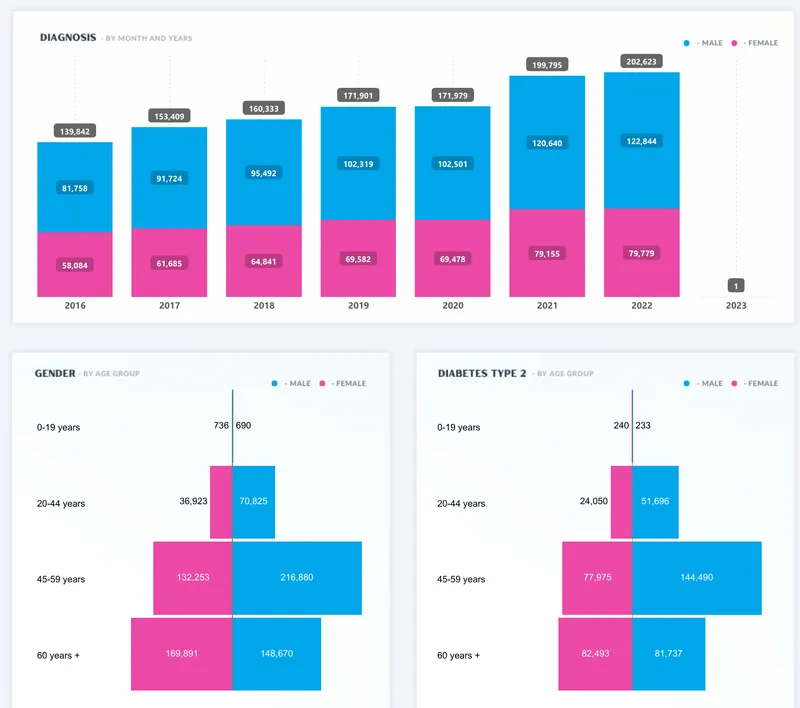
National public health authority — National population, hospitals and primary care clinics
Health information sat in separate places: the national disease registries, the records of each clinic and hospital, and new digital services such as electronic sick leave.
Client names are withheld. Specific commercial metrics are not published for confidentiality.
In detail
Explore the detail
Typical healthcare challenges
Patient records do not align consistently across systems
Clinician or doctor identifiers differ between sources
Prescription and dispensing data requires reconciliation
Appointments, activity, and utilisation are reported manually
Management reporting depends on spreadsheets
Operational KPIs are calculated differently by different teams
Data refreshes are slow or unreliable
Historical data is difficult to analyse
Data quality issues are discovered only after reporting
Sensitive information requires controlled access
Patient and appointment analytics
Understand activity, demand, utilisation, and service patterns
Datazeb can help structure reporting around approved patient and appointment data for operational and management use. The exact metrics should be defined with the client's operational and clinical stakeholders.
Appointment volume and trends
Bookings, cancellations, and no-shows
Patient activity over time
Clinic / location comparison
Service or appointment-type analysis
Utilisation and capacity indicators
New vs returning patient patterns
Operational exception reporting
Prescription and dispensing analytics
Bring prescribing and dispensing information into one clearer view
Where the required data is available and approved, Datazeb can support reporting across prescribing, dispensing, patient, product, clinician, and operational sources.
Prescription volume and trends
Dispensing activity
Doctor / clinician mapping
Product / medication analysis
Patient-level operational analysis where permitted
Source reconciliation
Exceptions and missing-data monitoring
Data quality in healthcare reporting
A polished dashboard cannot compensate for unreliable source data
Healthcare reporting often depends on relationships between people, appointments, products, clinicians, and transactions. Small mapping errors can create large reporting inconsistencies. Datazeb can build checks for: This helps surface problems before they become management-reporting errors.
Missing patient or clinician identifiers
Duplicate records
Invalid source combinations
Unexpected or incomplete dates
Reference-data mismatches
Unmapped clinicians or locations
Missing source feeds
Inconsistent status values
Multi-site healthcare reporting
Create a central view without losing local detail
For healthcare organisations operating across multiple clinics, locations, teams, or business units, Datazeb can support a common reporting model with controlled local drill-down.
Standard KPI definitions
Location comparison
Central management view
Local operational detail
Role-based access
Consistent patient / clinician / service mappings
Automated reporting across sites
Healthcare operations and management KPIs
Depending on the organisation, reporting may include:
Appointment activity
Service utilisation
Patient activity trends
Clinician activity
Prescription / dispensing volumes
Operational turnaround times
Location performance
Inventory / product activity
Data-quality exceptions
Financial or revenue measures where appropriate
Privacy, access, and control
Healthcare data requires disciplined access
Datazeb can design reporting and integration work around client-defined security, privacy, and access requirements.
Role-based access
Row-level security where appropriate
Limited exposure of sensitive fields
Approved source-system access
Separation of development and production access where required
Secure credential handling
Documentation of data flows and dependencies
FAQ
Frequently asked questions
Can you integrate data from multiple healthcare systems?
Often, yes. The integration method depends on whether the systems provide APIs, databases, exports, files, or supported connectors and whether the client has approved access.
Do you build healthcare dashboards in Power BI?
Yes. Datazeb can design Power BI reporting for operational and management use where the required data and access are available.
Can you help reconcile clinician or doctor data across systems?
Yes. Where source identifiers and business rules are available, Datazeb can create mapping and validation logic to improve reporting consistency.
Can you work with patient-level data?
Potentially, subject to the client's security, privacy, contractual, and jurisdiction-specific requirements. The required access model should be agreed before implementation.
Do you provide clinical advice or diagnostic AI?
No. Datazeb's healthcare positioning is focused on data engineering, analytics, operational reporting, automation, and controlled business-side AI use cases.
Make your healthcare data easier to reconcile, understand, and use
If reporting depends on disconnected systems, manual spreadsheets, or difficult data mappings, tell us what the environment looks like today. Datazeb can help determine the most practical next step – whether that is data integration, Power BI reporting, data-quality improvement, automation, or ongoing analytics support.